



How Proper PCB Cleaning Helps Reduce Ionic Contamination and Improve Reliability
Ionic contamination is one of the most overlooked threats to the long-term reliability of printed circuit board (PCB) assemblies. While a PCB may appear perfectly clean after assembly, invisible residues left behind from manufacturing processes can lead to corrosion, electrical leakage, and premature field failures.
What Is Ionic Contamination?
Ionic contamination refers to process residues on a printed circuit board that can dissolve in water and form electrically conductive ions. These are typically salts, acids, or bases left behind from flux, solder paste, cleaning solvents, human handling, and even bare board fabrication.
Think of them as “invisible short circuits waiting to happen.” The most common culprits: chlorides, bromides, sulfates, and weak organic acids from no-clean fluxes.
Why it matters: In the presence of moisture + voltage bias, ionic residues enable electrochemical migration, dendritic growth, and leakage currents. That means intermittent failures, SIR degradation, and field returns you can’t easily reproduce.
Common Sources of Ionic Contamination
- Soldering fluxes & pastes: Rosin, water-soluble, and no-clean fluxes all contain activators. No-clean doesn’t mean “no residue” — it means “designed to be safe IF process is in control.”
- Cleaning processes: DI water with high conductivity, contaminated wash baths, or insufficient rinse/dry cycles redeposit ions.
- Board fabrication: Etchants, plating chemistry, and HASL fluxes can trap ions in vias and under solder mask.
- Handling & environment: Fingerprints, airborne salts, tap water spray, and cardboard packaging are all classic sources.
- Component packaging: Some moisture-sensitive components or tapes release ionic materials at reflow temps.
How Ionic Contamination Causes Failure
- Surface Insulation Resistance (SIR) drop: Ions lower the resistance between conductors. IPC J-STD-001 expects >100 MΩ, but contamination can push you into the kΩ range under humidity.
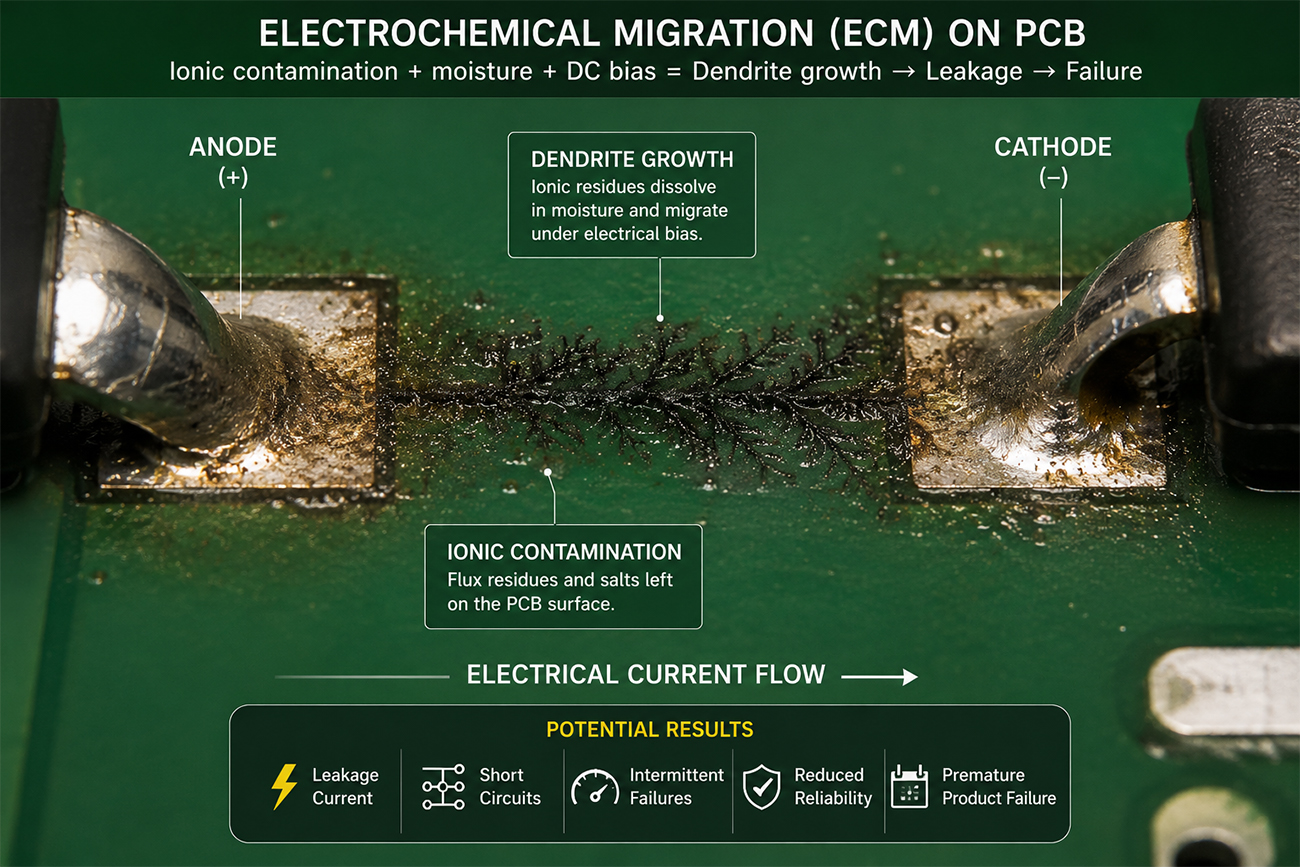
- Electrochemical migration: Voltage + moisture + ions = metal dendrites growing between traces. Result: shorts that “heal” when power is removed, making them a nightmare to debug.
- Corrosion: Chlorides especially attack copper, HASL, and ENIG finishes, creating opens over time.
- Adhesion issues: Conformal coating and underfill won’t bond to ionic residues, leading to delamination and “measling.”
The risk scales up fast with: fine pitch <0.5mm, high impedance circuits, Class 3 medical/aerospace, and anything running in condensing or high RH environments.
What Is Electrochemical Migration?
Electrochemical migration (ECM) is one of the most serious consequences of ionic contamination. When moisture combines with ionic residues and an electrical bias is present, metal ions begin migrating across the PCB surface. Over time, these ions form conductive metallic filaments known as dendrites.
As dendrites grow, they can bridge adjacent conductors, causing:
- Short circuits
- Increased leakage current
- Intermittent operation
- Permanent electrical failures
Because ECM develops gradually, failures may not appear until months or even years after the product has been deployed.
How Is Ionic Contamination Measured?
Visual inspection alone cannot determine whether a PCB is sufficiently clean. Many ionic contaminants are invisible.
Manufacturers use specialized cleanliness testing equipment to measure ionic contamination levels after cleaning. These systems evaluate the amount of ionic residue remaining on the assembly, helping verify that the cleaning process is effective and consistent.
Routine cleanliness testing offers several benefits:
- Confirms cleaning process performance
- Detects process drift before defects occur
- Supports quality documentation
- Reduces the risk of latent field failures
- Provides confidence for high-reliability applications
When combined with statistical process monitoring, cleanliness testing helps manufacturers maintain consistent production quality.
How PCB Cleaning Reduces Ionic Contamination
Effective PCB cleaning removes many of the contaminants that contribute to ionic contamination before products leave the manufacturing facility.
Modern automated cleaning systems are designed to remove:
- Flux residues
- Water-soluble contaminants
- Rosin residues
- Solder paste residues
- Handling contamination
- Dust and particulate matter
Automated wash, rinse, and drying cycles provide repeatable cleaning performance while reducing variability that can occur with manual cleaning methods.
How EMS, Inc. Controls Ionic Contamination
At EMS, removing ionic contamination isn’t limited to cleaning alone – it’s part of a comprehensive quality process. By combining automated PCB cleaning with post-cleanliness verification, EMS helps ensure every assembly meets stringent cleanliness requirements before shipment.
Automated PCB Cleaning with the Aqueous Trident XLD
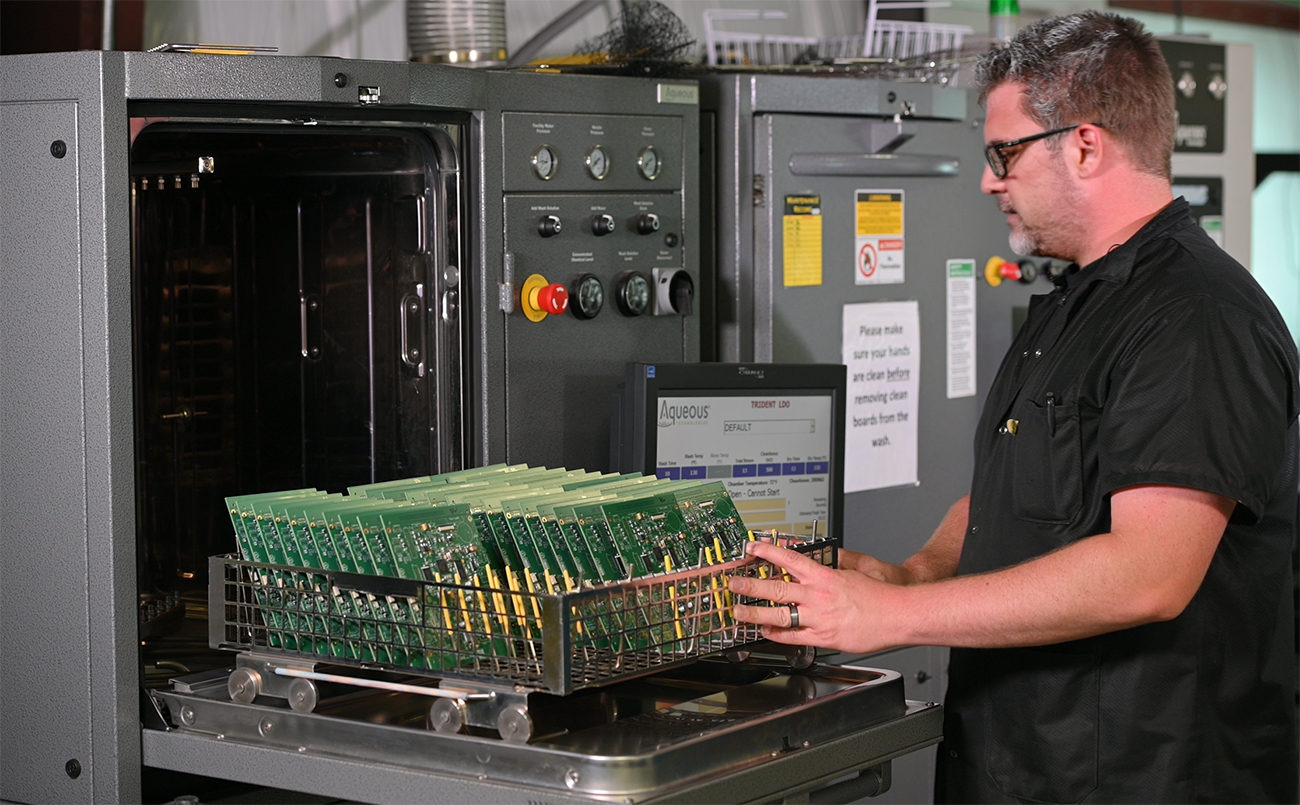
EMS utilizes the Aqueous Trident XLD automated PCB cleaning system to remove flux residues and other contaminants from assembled circuit boards. The system is engineered to clean today’s increasingly complex PCB assemblies, including boards with fine-pitch components and low-clearance packages.
Key benefits include:
- Effective removal of ionic contamination that can contribute to corrosion, leakage current, and electrochemical migration.
- Thorough cleaning beneath low-standoff components, where residues can be difficult to remove using conventional methods.
- Automated wash, rinse, and drying cycles that provide consistent, repeatable cleaning from one production run to the next.
- Support for multiple flux chemistries, including no-clean, rosin, and water-soluble flux residues.
- Optimized spray technology designed to improve cleaning coverage while reducing shadowing around densely populated assemblies.
- Reliable drying that helps ensure boards are ready for inspection, testing, conformal coating, or shipment.
- Process monitoring and data logging that support quality documentation and continuous process improvement.
By using an automated cleaning process, EMS minimizes process variation and helps deliver cleaner, more reliable PCB assemblies.
Verifying Cleanliness with the Aqueous ZERO ION Ionic Contamination Tester
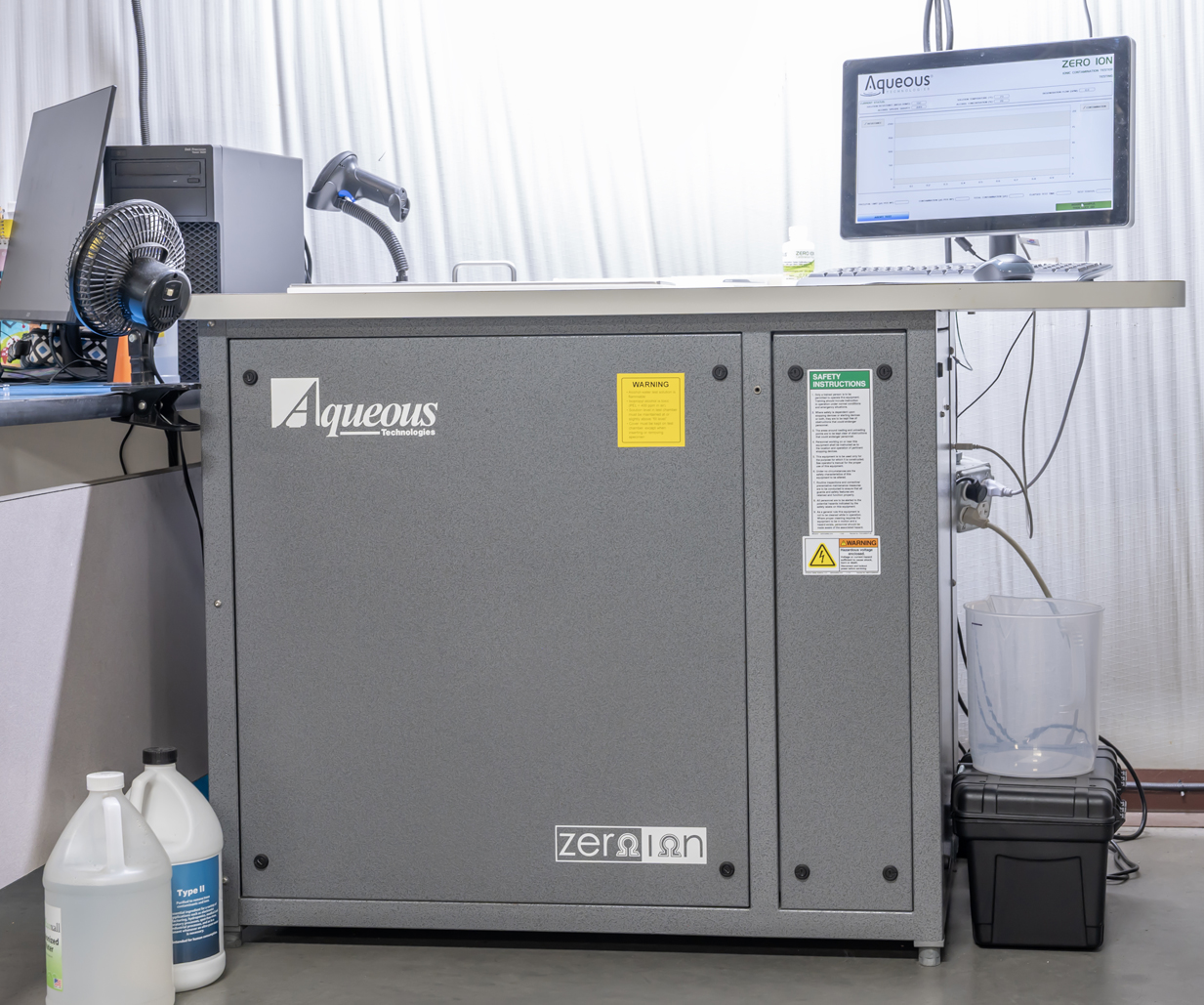
Cleaning is only one part of the process. EMS also verifies PCB cleanliness using the Aqueous ZERO ION Ionic Contamination Tester, a dynamic ROSE (Resistivity of Solvent Extract) testing system that measures residual ionic contamination after cleaning. The system complies with IPC cleanliness testing methods and is designed to provide highly sensitive, repeatable measurements.
Benefits of cleanliness verification include:
- Objective confirmation that PCB assemblies have been effectively cleaned.
- Detection of invisible ionic residues that cannot be identified through visual inspection alone.
- Support for IPC cleanliness requirements and customer-specific quality standards.
- Statistical Process Control (SPC) data collection, enabling trend analysis and process optimization.
- Comprehensive documentation and traceability for quality records and customer audits.
- Early identification of process deviations, helping prevent latent reliability issues before products reach the field.
Because the ZERO ION tester provides quantitative cleanliness measurements, EMS can validate the effectiveness of its cleaning process rather than relying solely on visual inspection.
Why EMS uses both together: ZERO ION tells us if a board is clean to IPC standards. Trident XLD ensures it gets clean and stays clean through the wash process. For Class 3, medical, and aerospace customers, that closed-loop combo is how we guarantee SIR performance before conformal coat or shipment.
What This Means for Your Project
- Reduced risk: Dendritic growth and ECM failures drop dramatically when ionic levels are verified, not assumed.
- Audit-ready data: We provide ZERO ION test reports with each lot if required for AS9100, ISO 13485, or customer-specific specs.
- Process transparency: If you’re switching to a new flux, alloy, or board shop, we’ll run IC + ROSE qualification on the Trident/Zero Ion to prove it works before volume.
Have a no-clean process you’re not sure about? Or a wash process that needs validating?
EMS, Inc. can test your current assemblies and establish ionic control limits using the same Aqueous ZERO ION and Trident XLD systems we run in production. Contact us – let’s make sure “no-clean” doesn’t mean “no-data.”